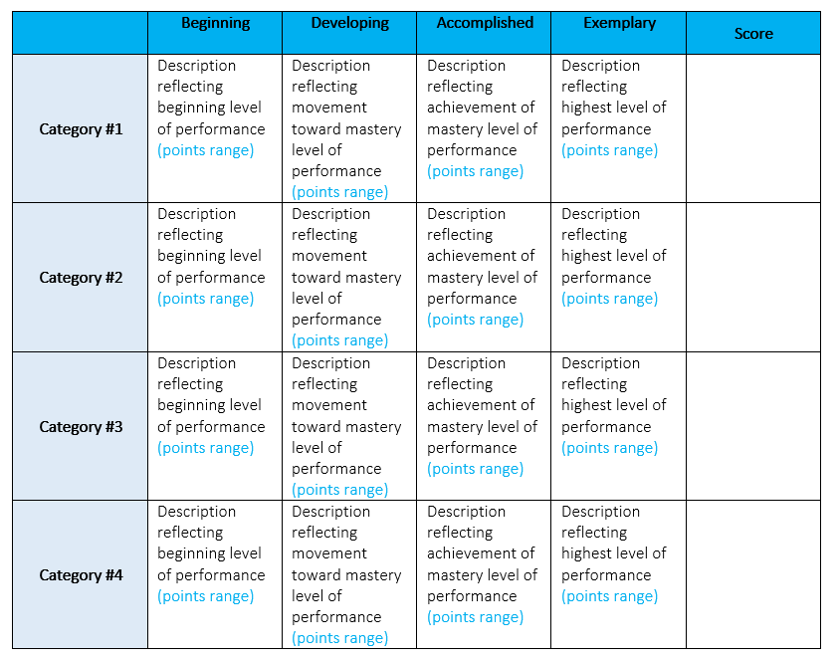
Analytic Rubrics
Learning MaterialsRubrics
Select each tab to view the learning materials for this section. Be sure to review all tabs before moving on to the next module.
What is a Rubric?
A rubric is a tool that you will use as an educator to clearly communicate expectations, evaluate student work consistently, and provide meaningful feedback. It outlines the specific criteria you will assess (such as clarity, accuracy, or communication) and describes different levels of performance for each criterion (Fully Met, Met, Partially Met, Not Met).
Rubrics are typically formatted as a table, where each row is a skill or outcome being assessed, and each column defines what it looks like to meet or not meet that standard.
When used correctly and with purpose, rubrics help your students understand what success looks like before they begin an assignment. They also allow you to grade fairly, reduce subjectivity, and streamline feedback, especially when evaluating subjective work like presentations, reflections, or group projects. Rubrics are especially valuable when you are teaching multiple learners, working with co-instructors or TAs, or assessing competencies over time.
Types of Rubrics
It is essential to select the appropriate type of rubric based on your learning objectives, the task’s complexity, and the level of feedback you wish to provide. Below are the most commonly used rubric types in education, along with examples of when each might be most suitable.
Checklist Rubric
A checklist rubric is the most basic type, used to confirm whether key elements are present or completed. It doesn’t assess quality, just completion.
- Best for simple or procedural tasks.
- Binary (yes/no, complete/incomplete) format
- Great for clinical skills, lab steps, or formatting checks
- Quick to grade, minimal feedback
| Hand hygiene before/after | ||
|---|---|---|
| Assembled supplies correctly | ||
| Maintained sterile field | ||
| Provided patient education |
Analytic Rubric
An analytic rubric breaks the task into multiple criteria and describes performance levels for each. It’s the most detailed and commonly used rubric in education.
- Best for assignments where feedback on multiple dimensions is important.
- Supports consistent grading and clearer feedback
- Useful for presentations, papers, projects, and clinical reasoning
- Includes rows (criteria) and columns (performance levels)
| Criteria | Exemplary (4) | Proficient (3) | Developing (2) | Needs Improvement (1) |
|---|---|---|---|---|
| Clinical Reasoning | Synthesizes patient data, anticipates issues | Mostly accurate with minor gaps | Basic interpretation | Incomplete or inaccurate |
| Communication | Clear, empathetic, professional | Mostly clear | Sometimes unclear or rushed | Unprofessional or difficult to follow |
Holistic Rubric
A holistic rubric gives a single overall score based on an overall impression of the work. It is faster to use but offers less specific feedback.
- Best for low-stakes assignments or when overall quality is more important than individual parts.
- Scored using 1 overall rating (e.g., 1–5 scale)
- Commonly used for reflection papers or group collaboration
- Useful for fast grading or large groups
| Score | Descriptor |
|---|---|
| 5 – Outstanding | Insightful, well-articulated, thoughtful connection to practice |
| 3 – Satisfactory | Reflective but general; adequate clarity |
| 1 – Needs Improvement | Surface-level reflection or off-topic |
Single-Point Rubric
A single-point rubric lists only the expected level of performance, allowing room for narrative feedback on what exceeds or falls short.
- Best for feedback-focused, formative assessments.
- Encourages student growth and self-reflection
- Flexible and less overwhelming than full analytic rubrics
- Great for drafts, peer review, and student-led evaluation
| Criteria | Feedback |
|---|---|
| Information is accurate, clear, and culturally appropriate | Strengths: … Areas to improve: … |
Developmental Rubric
A developmental rubric shows student progress over time across stages (e.g., novice → expert). It’s commonly used in competency-based education.
- Best for tracking skill development or long-term learning.
- Describes what learning looks like at each developmental stage
- Great for portfolios, professional behaviors, and clinical progression
- Aligns with competency frameworks (e.g., EPAs, AACN Essentials)
| Level | Description |
|---|---|
| Novice | Uses medical jargon, avoids eye contact |
| Developing | Attempts empathy, needs prompting |
| Proficient | Communicates clearly and respectfully |
| Expert | Models therapeutic communication and self-correction |
Structured Observation Guide (SOG)
A structured observation guide is used for real-time evaluation of behaviors or performance in clinical or practical settings.
- Best for live assessment of communication, procedures, or professionalism.
- Checklist or comment-based tools used during observation
- Often paired with simulations or OSCEs
- Helps assess soft skills, interactions, and application
| Observation Area | Observed (✔) | Not Observed (✘) | Comments |
|---|---|---|---|
| Greets patient using name | |||
| Uses open-ended questions | |||
| Summarizes patient concerns | |||
| Maintains appropriate body language |
Analytic Rubrics
Analytic rubrics are structured scoring tools that break down assignments into individual assessment components, such as clarity, organization, reasoning, or professionalism. Unlike holistic rubrics that offer one overall score, analytic rubrics assess and provide feedback across multiple dimensions, making expectations more transparent and actionable. This multi-criteria approach helps students understand exactly what excellent work looks like and allows educators to offer targeted feedback on specific strengths and areas for improvement.
Because analytic rubrics deliver both detailed feedback and consistent evaluation, they are the most widely used rubric format in education. Educators value their ability to support objective grading, even in large courses or when multiple graders are involved. Students benefit from clear guidance on performance expectations and strategies for improvement. Analytic rubrics align well with competency-based education models and are ideal for evaluating complex tasks such as essays, presentations, clinical case studies, and final projects.
Watch the lecture video – “What is an Analytic Rubric”
Why, Where, and How of Analytic Rubrics
WHY: Why Use Analytic Rubrics?
Analytic rubrics improve both teaching and learning by making grading criteria clear, consistent, and aligned with course objectives. When students understand what’s expected, they ask fewer clarification questions and can better self-assess their work before submitting.
For instructors, rubrics reduce grading time and improve objectivity, which is especially helpful when multiple graders or TAs are involved. In health professions education, they also support program-level assessment and help ensure alignment with frameworks like CEPH, ACGME, and AACN Essentials.
WHERE: Where to Build and Use Rubrics
Rubrics can be created in simple tools like Word or Excel for syllabi, handouts, or documentation. Canvas offers a built-in rubric tool that integrates directly with assignments, discussions, and outcomes. Using Canvas and other LMS systems with integrated rubrics allow you to streamline grading, provide instant feedback, and maintain a digital record of performance.
Canvas Guide: How to Add a Rubric to an Assignment
Canvas Tip: Be sure to check “Use this rubric for assignment grading” so Canvas can auto-calculate scores based on the point values you define.
WHEN: When to Use Rubrics
Rubrics are most effective when used throughout the learning process, not just at the end. Best Practice: Share the rubric with students before they begin the assignment so they understand how they’ll be evaluated. During the assignment, refer any questions that can be addressed back to the rubric, including peer reviews, check-ins, or draft submissions. After grading, return the completed rubric to provide structured feedback and highlight areas of strength and improvement. Rubrics work equally well for formative assessments (to guide student growth) and summative assessments (to ensure fair and transparent grading).
HOW: How to Build and Use Analytic Rubrics
To create an effective rubric, begin by clearly defining your learning objectives. Break down the assignment into 3–5 key criteria that represent what you’re assessing, such as accuracy, application, communication, or professionalism. Define 3–4 levels of performance using specific, observable language for each level. Assign point values for each row, either equally or weighted. Once finalized, test your rubric with sample student work and revise if needed. If you’re using Canvas, attach the rubric to the assignment and enable it for grading to simplify scoring and feedback.
Rubric Comparison Table
| Rubric Type | Purpose | When to Use | Example Use Case |
|---|---|---|---|
| Checklist Rubric | To confirm completion of required tasks or elements | Simple tasks, procedural skills, formatting, or compliance | Skill check-offs, lab procedures, and assignment formatting |
| Analytic Rubric | To assess multiple criteria with detailed feedback | Complex assignments needing structured, criterion-level scoring | Papers, presentations, clinical reasoning, group projects |
| Holistic Rubric | To assign an overall score based on general impression | Fast grading, low-stakes tasks, and broad performance review | Reflection journals, participation, and discussion posts |
| Single-Point Rubric | To provide focused feedback around expected performance | Formative feedback, drafts, peer/self-assessment | Draft reviews, peer evaluations, brochures, concept maps |
| Developmental Rubric | To measure progress across stages of learning | Longitudinal assessment, skills development over time | Professional behaviors, clinical milestones, and capstone portfolios |
| Structured Observation Guide (SOG) | To evaluate live performance in real-time | OSCEs, simulations, clinical encounters, soft skills assessment | Communication, professionalism, teamwork, and patient interaction |
Best Practices
1. Align with Learning Objectives
Every criterion in your rubric should directly connect to what students are expected to learn or demonstrate.
Example:
- Learning Objective: Students will demonstrate clinical reasoning by integrating patient data into a differential diagnosis.
- Rubric Criterion: Accuracy and logic of clinical reasoning in a case write-up.
Tip: Avoid vague or general criteria like “quality of work” or “effort.” Use specific language tied to outcomes.
2. Use Clear and Observable Language
Performance levels should describe what students actually do. Use concrete, measurable terms.
Avoid terms like:
- “Good content”
- “Somewhat clear”
- “Nice effort”
Use instead:
- “Integrates relevant patient history, symptoms, and labs”
- “Supports treatment plan with evidence-based references”
3. Keep the Rubric Manageable
Avoid overloading your rubric with too many criteria or performance levels.
- Include 3 to 5 key criteria
- Use 3 to 4 performance levels (such as Exemplary, Proficient, Developing, Needs Improvement)
Tip: Combine overlapping ideas into a single row or divide broad criteria into smaller, more focused parts.
4. Define Each Performance Level Clearly
Ensure that each level demonstrates a clear, measurable improvement in performance. Avoid unclear terms like “more,” “better,” or “somewhat.”
Example: Criterion – Clinical Reasoning
- Exemplary: Synthesizes all relevant data into an accurate diagnosis and plan
- Proficient: Mostly accurate with minor omissions
- Developing: Incomplete reasoning or unclear connections
- Needs Improvement: Inaccurate or missing diagnosis
Tip: Use language that describes specific behaviors or actions that could be observed or measured.
5. Weight Criteria Intentionally
Unless you have a specific reason, keep point values equal across all rows. If some skills are more important, you can assign more points to those criteria.
Example:
- Communication = 5 points
- Clinical reasoning = 10 points
Tip: Make sure the total point value matches what you want the assignment to emphasize.
6. Pilot Test and Revise the Rubric
Before using your rubric for grading:
- Apply it to one or two sample assignments
- Ask a colleague or teaching assistant to try using it
- Look for vague, repetitive, or confusing language
- Revise based on what you learn
Tip: When you score a sample, does the result match your true expectations?
7. Share Rubrics Before Students Submit Work
Rubrics should guide student learning and not just be used after grading.
- Post the rubric along with the assignment prompt
- Review it briefly in class or in a short orientation video
- Encourage students to self-assess with the rubric before submitting
Tip: Ask students to submit the rubric with their assignment and indicate where they believe their work falls.
8. Use Rubrics to Give Feedback, Not Just Grades
Even when scores are used, rubrics should offer targeted, constructive feedback.
- Highlight one strength
- Suggest one specific improvement
- Use the comment box in Canvas (other LMS) to add short notes under each criterion
9. Review and Improve Rubrics Each Term
Rubrics should be updated based on their performance in practice.
- Look for common patterns in scores or feedback
- Ask students and graders what worked or was unclear
- Adjust confusing descriptors or rebalance weights as needed
10. Design for Accessibility and Equity
Rubrics should be clear, fair, and understandable to all students.
- Use plain, jargon-free language whenever possible
- Avoid assumptions or culturally biased criteria
- Provide examples of completed rubrics or annotated student work
- Define terms like “synthesize” (e.g., “combine patient details to make a clinical decision”)
Optional Activity: Quick Rubric Audit
Choose a rubric you have used or are developing. Ask yourself:
-
Does each criterion align with a specific learning objective?
-
Are the performance levels clear, distinct, and measurable?
-
Could another instructor use this rubric and arrive at the same score?